Book of the Day Posted Feb 12, 2022

Book of the Day > *Signed*​ John Free: End Of The Line — Railroad Tramps Of The Los Angeles Freight Yards

● Purchase ● One day in 1974 John Free took his white dog Casper and his black Nikon camera to the Los Angeles Freight yards on an invite from a stranger to meet under a bridge to see "how a real tramp lives." Under that bridge he found the "Home Guard of the Taylor Yard," at the End of the Line, as far west as one could travel on trains and the best place for an old railroad tramp like shorty, Old Man PeeWee or Bobbi K, to live out their days. It's a part of Los Angeles that is now gone.
 
"They thought I was interested in the trains but it was their stories, their smiles and my respect for them that kept me coming back."
 
End of the Line is a collection of John's black and white, candid, full frame available light photographs. These rare historical images document a place an culture that no longer exists. The book also includes the unique and moving stories told to John by the tramps as well as John's approach to getting to know these unique people and his unique photographic techniques. The Foreword by his son Scott describes what it was like growing up as a street photographer's son. Also included are an historical perspective by Kevin Keefe, former editor of Trains Magazine, a glossary of tramp terminology and technical details of the photographs. 
Book of the Day Posted Feb 11, 2022

Book of the Day > Nick Haymes: The Last Survivor Is The First Suspect

● Purchase ● The Last Survivor is the First Suspect is at once a celebration and a requiem. The project, captured between 2005 and 2009 by photographer Nick Haymes, is a record of a drifting community of young friends based mainly between two distinct geographic points: Southern California and Tulsa, Oklahoma. The book's narrative merges a sense of joy in documenting burgeoning friendships and bonds, and a looming sense of dread that would ultimately culminate in a series of tragedies.
 
Weaving throughout Haymes intimate photographs are a series of digital screenshots which Haymes has identified as key to this moment in time, which offer the viewer a secondary narrative of engagement. Social media was still relatively young and Haymes became acutely aware of a new nodal sense of communication between these distinct groups of friends. Platforms such as MySpace, YouTube and online message boards engendered a sense of community by enabling connection, while also setting new and impossible standards and expectations. Diligently collected, these various forms of communication between the characters frame a foreboding.
 
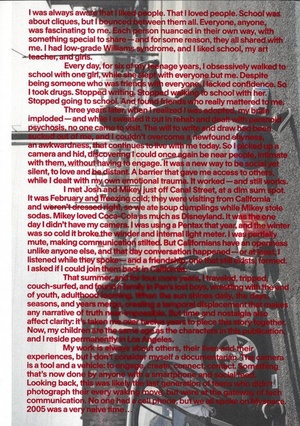
In Haymes’ own introduction to the book, he accounts how his camera allowed him to compensate for a sense of crippling shyness developed during his teenage years. ’I picked up a camera and hid, discovering I could once again be near people, intimate with them, without having to engage,’ he writes. To create this exhibition and publication, the artist has returned to a body of pictures, piecing together what happened to these people for himself. Here, Haymes invites us to form a contemporary engagement with this specific historic moment, where things are both different and the same in equal measure. L.P. Hartley famously opened his coming-of-age opus The Go-Between ’The past is a foreign country; they do things differently there.’ The Last Survivor is the First Suspect shows this sentiment with remarkable clarity.
Book of the Day Posted Feb 09, 2022

Book of the Day > Robert H. Boltz: Dead of Night

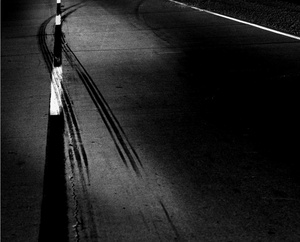
● Purchase ● "In the middle of the night, I woke up to a loud noise. Grammy and I ran to the front porch. A car had crashed into a telephone pole. Grammy told me to go back inside. “Right now!!!” When I woke up the next morning, the car was gone.
 
Several years ago, I bought the photographic archive of Bob Boltz, of West Bend, Wisconsin. Boltz’s primary subject was car crashes; the shots were taken at night. Almost none of his pictures showed the people who’d been injured. Their absence is a haunting reminder of the couple who died outside Grammy Keaton’s home all those many years ago.
 
Boltz’s nighttime photographs have a richness similar to that of 1930s black-and-white crime films. I like to think he may have been an admirer of movies like Scarface, with Paul Muni, and The Public Enemy, starring James Cagney. Each car is lit with a nightmarish, chiaroscuro quality. His framing matches the technique of horror and suspense films in which shadows provide gloomy details of the surroundings. The photographs remind me of genres where light and dark represent good and evil. This book is a hymn to unsolved mysteries discovered in the dead of night." –Diane Keaton
Book of the Day Posted Feb 05, 2022

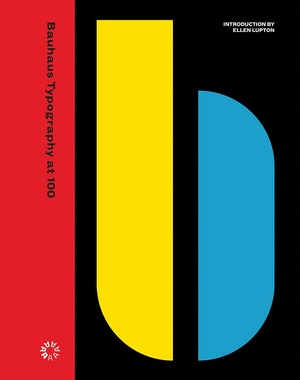
Book of the Day > Bauhaus Typography at 100

● Purchase ● An unprecedented look at the school’s typography and print design, from its early expressive tendencies to the functional modernism for which it is famed today
 
Known for its bold sans-serif typefaces, crisp asymmetrical grids and clean use of negative space, the Bauhaus emerged as the forebearer of a new look—one that seized the tools of mass production in the creation of a radical new art. Today, just over 100 years after the Bauhaus’s opening in 1919, the school’s visual hallmarks have come to define modernity as it appears on the printed page.
 
The official catalog for Letterform Archive’s inaugural gallery exhibition, Bauhaus Typography at 100 explores the school’s legacy in graphic and typographic design through artifacts of its own making—its books, magazines, course materials, product catalogs, stationery, promotional fliers and other ephemera.
 
From the book’s beautifully designed pages, readers learn of typographic masters László Moholy-Nagy, Herbert Bayer and Joost Schmidt, who channeled Constructivism’s geometric forms and optimism for industry into printed vehicles for the school’s teachings. Here is where Bauhaus typography—its rejection of serifs and capitals, embrace of experimental alphabets, insistence on universal clarity, and innovation in layering and hierarchy—took its distinctive shape.
 
The catalog also shines light on the Bauhaus’s lesser-known early forays into expressive lettering and illustration, also tracing the school’s immediate impact on seminal design movements such as the New Typography and, of course, on design practitioners working today. Lavishly illustrated, carefully researched and written, and accompanied by an in-depth introduction from noted Bauhaus expert, author and curator Ellen Lupton, Bauhaus Typography at 100 is a must-have for any fan of modern design.
Book of the Day Posted Feb 04, 2022

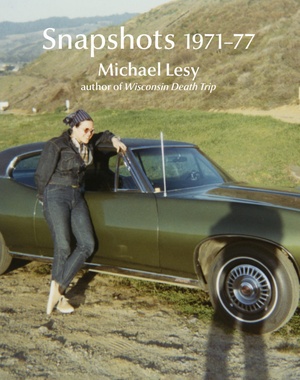
Book of the Day > Michael Lesy: Snapshots 1971–77

● Purchase ● In the summer of 1971, Michael Lesy and a friend found most of the snapshots in Snapshots 1971–77 in a dumpster behind a gigantic photo-processing plant in San Francisco. The photos were in the trash because the machines that printed them made them so fast—duplicates, triplicates, quadruplicates—that the people on the processing line couldn’t stop them. Lesy took home thousands of the discards from the dumpster. By the end of the summer, he’d formed his own collection of images of American life.
 
While Lesy looked through other people’s lives in pictures, the world was coming apart at the seams. The Vietnam War, the murderous rampage of the Manson Family, and the Attica State Prison uprising filled news headlines—and the general public carried on their lives, with hope and abandon and everything in between: chaos, cruelty, familial bonds and breaks, lawlessness, unwitting humor.
 
Lesy’s collection of snapshots from the 1970s is a time capsule of things familiar and alien. Now, fifty years later, everything and nothing about our lives has changed.
 
In Wisconsin Death Trip Lesy pulled back the curtain of “the good old days” to reveal the stark reality of American life from 1890 to 1910. The anonymous images in Snapshots 1971–77 serve as prophesies of present-day broken dreams, toils, and tribulations.
Book of the Day Posted Feb 03, 2022

Book of the Day > Matthew Angelo Harrison

● Purchase ● The first monograph on an important young American artist, generously illustrated with color images of his work.
 
In his sculptures and installations, Matthew Angelo Harrison (b. 1989) engages with the legacies of racism and colonialism, parsing their contemporary connections to labor in the United States through an evolving visual language. With works that merge manufacturing technologies with the formal concerns of modernism and minimalism, the artist questions ideas of authorship and reproduction. Harrison's sculptures often include found objects—including traditional African figurines and auto industry ephemera—encased in resin blocks. Frozen and entombed, these sculptures appear as strangely haunted minimalist objects, both ancient and futuristic. This generously illustrated volume, published in conjunction with two major solo exhibitions, is the first monograph on an important young American artist.
 
Another specter haunting Harrison's work is that of Detroit's defunct auto industry. A native of Detroit who once worked making prototypes in an auto manufacturing plant, Harrison sometimes employs precision machine-tooling techniques that are derived from those used by auto makers. In other works, Harrison replicates rare African masks and sculptures using hand-built, low-resolution 3D printing machines, rendering large-scale forms in wet clay—fragile, imperfect, and subject to glitches. In addition to color photos of Harrison's work and images that illustrate the artist's relationship to Detroit, the book features essays by curators and art historians Jessica Bell Brown and Elena Filipovic, as well as a conversation between Harrison and musician and theorist DeForrest Brown, Jr., led by curator Taylor Renee Aldridge.
Book of the Day Posted Feb 02, 2022

Book of the Day > Captivate! Fashion Photography from the '90s

● Purchase ● The nineties are back! Fashion icon Claudia Schiffer takes readers on a personal journey through the golden age of the global supermodel.
 
This richly illustrated book accompanies the first ever exhibition curated by Claudia Schiffer, who brings together the legendary fashion photographers, designers and supermodels, whose visions captivated fashion's most illustrious decade. In the nineties fashion became elevated into a total work of art. This stunning book draws on a rich panorama of amazing characters and places, which made the decade so memorable. Spectacular images by legendary photographers are shown alongside unseen material from Schiffer's private archive. Arthur Elgort's extravagant compositions are shown next to Corinne Day's intimate and immediate style; Ellen von Unwerth's playful, sexy, humorous, and exuberant photographs meet Herb Ritts' sculptural, perfectly composed works; Juergen Teller's provocative photographs contrast with Karl Lagerfeld's elegant and timeless images; and many other iconic photographers are featured. Insightful essays by the fashion industry's leading lights reveal the secrets of a decade, which continues to have a strong influence on the fashion culture of today.
Book of the Day Posted Feb 01, 2022

Book of the Day > David Hockney: Moving Focus

● Purchase ● A unique overview of David Hockney's prolific range and activity
 
David Hockney has been delighting and challenging audiences for sixty years and celebrated artworks from across his career are at the centre of Tate’s outstanding collection. This book features over a hundred of these paintings, prints, drawings and photographs, helping the reader to understand the artist’s changing sources of inspiration and, crucially, where his work is going. Beginning in the 1950s when he made his first steps to becoming a modern artist, the publication charts Hockney’s ground-breaking images of the early 1960s through to his famous depictions of the Los Angeles cityscape. It also looks at Hockney’s much-loved portraits from the 1970s and his discovery of a new way of dealing with time, space and perspective he called ‘Moving Focus’, as well as more recent landscapes and digital images that demonstrate his lifelong preoccupation with pictorial space and how we look at and experience the world around us.
 
As well as providing a unique overview of Hockney’s prolific range and activity, this book features new texts and responses to his work by established and emerging voices from the worlds of art, design, literature and performance. Breathing new life into the nexus of Tate’s collection, it speaks to the artist’s refusal to conform during periods of uncertainty and polarization as he traversed the boundaries of class, sexuality and high art and how his work still surprises, unsettles and addresses younger generations of viewers.
Book of the Day Posted Jan 28, 2022

Book of the Day > Marchand and Meffre: Movie Theaters

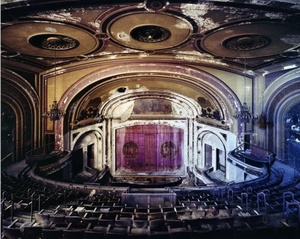
● Purchase ● Following on the heels of their incredibly successful The Ruins of Detroit, this major new project by the prolific French photographer duo Marchand/Meffre, poignantly eulogizes and celebrates the tattered remains of hundreds of movie theaters across America.
 
They are in every American city and town—grandiose movie palaces, constructed during the heyday of the entertainment industry, that now stand abandoned, empty, decaying, or repurposed. Since 2005, the acclaimed photographic duo Marchand/Meffre have been traveling across the US to visit these early 20th-century relics. In hundreds of lushly colored images, they have captured the rich architectural diversity of the theaters’ exteriors, from neo renaissance to neo-Gothic, art nouveau to Bauhaus, and neo-Byzantine to Jugendstill. They have also stepped inside to capture the commonalities of a dying culture— crumbling plaster, rows of broken crushed-velvet seats, peeling paint, defunct equipment, and abandoned concession stands—as well as their transformation into bingo halls, warehouses, fitness centers, flea markets, parking lots, and grocery stores. Using a large format camera, the photographers’ carefully composed images range from landscape exteriors to starkly beautiful closeups. Presented here in a gorgeous oversized format, exquisitely printed with superior inks and spot varnish, this illustrated eulogy for the American movie palace is certain to become a modern-day classic.


Book of the Day Posted Jan 26, 2022

Book of the Day > Brian Blomerth: Mycelium Wassonii

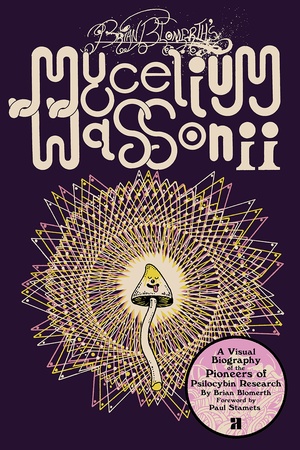
● Purchase ● Brian Blomerth first fused his singularly irreverent underground comix style with heavily-researched history in 2019’s Bicycle Day, a Technicolor retelling of the discovery of LSD. Now, the illustrator and graphic novelist continues his wild and woolly excursions into the history of mind expansion with Mycelium Wassonii, an account of the lives and trips of R. Gordon and Valentina Wasson, the pioneering scientist couple responsible for popularizing the use of psychedelic mushrooms in the United States. The Wassons’ journeys took them from Russian folk wisdom to midcentury Manhattan, from the indigenous traditions of the Mazatec people of Mexico to the mysteries of ancient Rome. A globetrotting vision of science and mysticism with appearances by J.P. Morgan, Robert Graves, Life Magazine, and the CIA, Mycelium Wassonii is a visual biography and a tragic love story as only Blomerth’s Isograph pen can render it.
more